One of the oldest written documentations of an ancient lock was provided by Italian architect Joseph Bonomi (1739-1808). In his works he describes a lock found at the Palace of Sargon (part of the Assyrian Empire of the 700’s BC). The lock described is similar to 4000 year old Egyptian locks that have been found.
Our private collection of antique locks and collectibles is not quite this old, however we are very proud of our sizable collection and have decided to use our website to share just a handful of our favourite and interesting pieces. Most of the items displayed were produced in British factories like the Chubb lock works (pictured) in Wolverhampton that stands as a monument to our world class innovation and manufacture of security products.
The collection has been built up over the entirety of the careers of our staff.
Welcome to Abbeygates online lock and locksmiths museum. Based in Reading, Berkshire we have built up a large collection memorabilia over the Years. Sadly we can not share it all with the public but we hope our museum can give you a glimpse into the history of our industry.
LOCKS AND LOCKING DEVICES
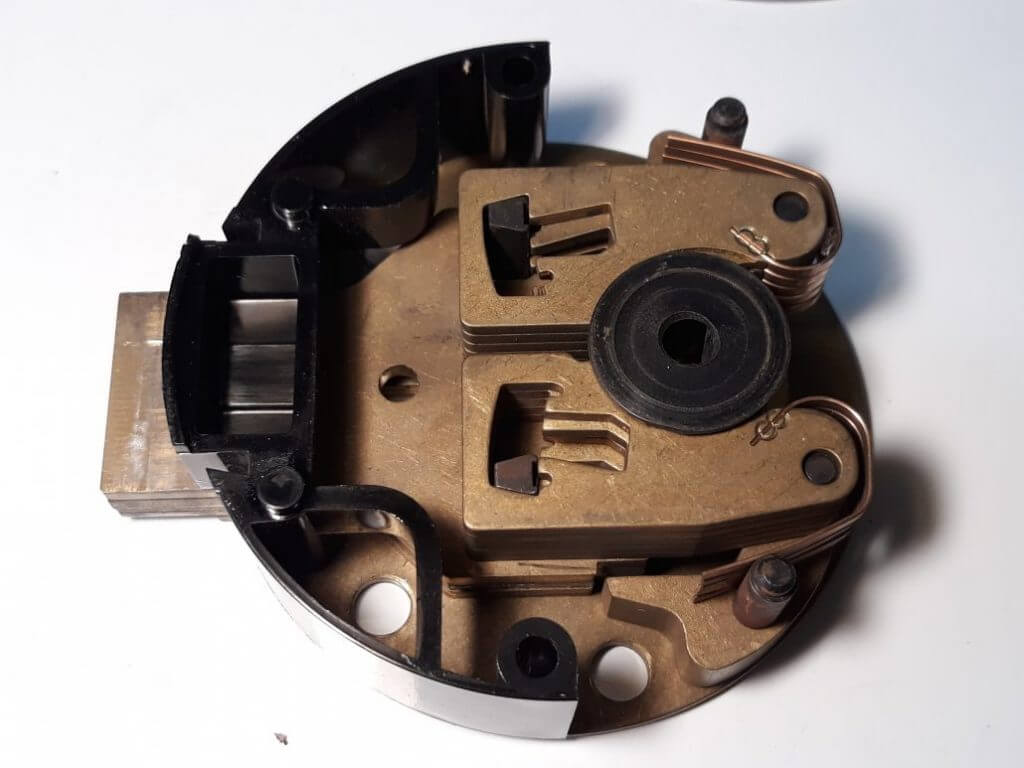
The lock to the left measuring 240mm by 210mm was produced by Hobbs in the mid 1800’s for a safe. The most distinguishing feature of the lock are the large brass levers, with the springs curving from them. There are 7 of these levers and springs measuring 140mm and are moved using the key. The lock is known as an “Anti-violence” lock and has anti pick notches that stop it working if it is attacked. Hobbs would later change its name to Hobbs, Heart and co.
When talking about locks its impossible not to talk about Yale. The original business was set up in 1868 in Stamford, Connecticut as the “Yale Lock Manufacturing Co” (later “Yale and Towne”) and steadily became a world leading manufacturer.
In 1928 they brought British lock manufacturer H&T Vaughan (the first British company to produce a Pin Tumbler lock like the one pictured) and this became the starting point of their main UK operation.
The lock pictured is and original H&T Vaughan 04 model and was produced in this form between 1910 and 1928 when they were bought by Yale. Note the distinctive H&TV knob.
The photos right shows a H&T Vaughan catalogue, printed the the early 1900’s. When reading this 192 page book its clear many of the products have a striking resemblance to later Yale products.
Unbelievably this was rescued out of a skip during a refurbishment of a large estate in the early 1990’s. This lock is 35cm (350mm, 12 inches) long and 20cm (200mm, 8 inches) tall. The bolt has the manufactures name “Pickett Marlbro” embossed on it and is commonly known as a “box of wards” lock.
This cupboard lock has a built-in bell. The device rings when the key is turned informing anyone nearby the door has been opened – simple.
There are many examples of locks that have been modified. Other mechanical locks in our collection include locks with complex clock mechanisms built inside. The function of the clocks allows the user to control precisely when the user may open the lock.
The small door with a combination lock above is from America and is commonly found as part of a bank of letter boxes in apartment blocks. It’s one of Stephen’s favourites because it reminds him of the 60’s cop shows he watched as a child.
This large lock is from a cell at the old Reading Police station located on Blagrave Street in Reading before its relocation to Castle Street in the early 1970’s.
Our crime and punishment collection also includes handcuffs from the 1970’s and a wide range of prison keys.
The featured lock is a Mersey Lock produced in 1986. The lock was produced for the Ministry of Defense (MOD) and the North Atlantic Treaty Organisation (NATO) during the cold war in the 1970’s and 1980’s.
The lock has an unusual “V” shaped brass key (earlier models had a plastic key that was prone to breaking). The lock also has a plastic cover locked into place by the mechanism itself and can only be taken off using the key. the reason was to stop the lock being tampered with between manufacturing and fitting. As you can see from the photo each lock had its own NATO code and serial number.
This lock would have been a common site at the old USAF base at Greenham Common, Just outside Newbury and Thatcham in West Berkshire
If you are interested in classic cars this lock is for you. This is a lock from a Rolls Royce Silver Shadow. The lock was fully restored in the early 90’s for a garage in Reading with new keys cut. This customer however, never returned to reclaim or pay for the lock and it hence ended up in our collection.
Abbey Gate’s collection includes a wide range of padlocks in a wide range of sizes. One of the most interesting padlocks is the one pictured on the right. The photo shows a HM revenue and customs brass padlock. The lock was produced by Chubb and clearly shows the E.R. (that stands for Elizabetha Regina) crest with the crown above.
This lock is designed to be in a bank vault, it operates using two keys, one held by the owner of the products inside, the other by the bank.
In the collection we have a very simple Chubb cash box with a very simple lock and handle, handy for a criminal running away!
This padlock is a Kastor patented by a company called Keitner in the 1940’s. The padlocks was produced in Austria and was commonly used during World war 2. The lock is unusual because the key does not turn in the lock, once pushed it the lock simply pops open.
We found this padlock tucked away in a shop in Basingstoke, and we liked it! The padlock is from the 70’s and 80’s and is produced by a company called ERA. ERA have been producing locks for over 175 years and today are one of the leading lock and hardwear companys operating in Britain.
From the same shop in Basingstoke, North Hampshire and another ERA lock, this time a night latch in original box, again from the 70’s and 80’s. We beleve that due to the fact both ERA products were in excellent condition they must have come from a hardwear shop formally in Basingstoke.
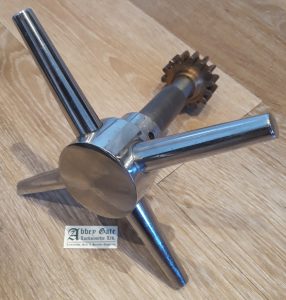
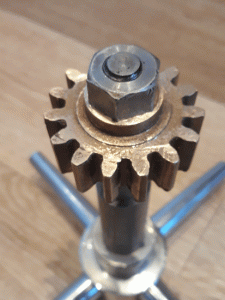
The images to the left and right show one of a pair of handles used to close a Chatwood Milner vault. One handle (not pictured) is exactly the same as the one pictured however instead of a cog has a large screw. When closed the screw pulls up the door to the closed position. The cog on the handle pictured works the locking mechanism inside the door. The handles were removed from a vault in Newbury, West Berkshire.
Our collection also includes scores of handles, knobs and escutcheon of many shapes, sizes and finishes. Many look as you would expect however some are more unusual. This brass handle comes from a safe in Marlow, Buckinghamshire, and is shaped in the form of a fist clutching a bar.
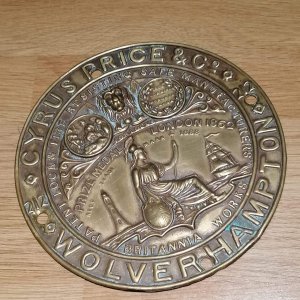
We boast a very large collection of safe identification plates spanning well over 100 years. Other Companies plates in the collection included Chubb, Midland safe company, Burg Wachter, Milners, Sentry, Secure safe and John Tann.
More items from vaults in West Berkshire now, this time Hungerford. The picture on the right displays two large bolts that lock a door in place. Each one is the size of a fist and originally came in a set of 26 (left). the ball bearing photoed alongside the bolts would have originally been located in the hinge.
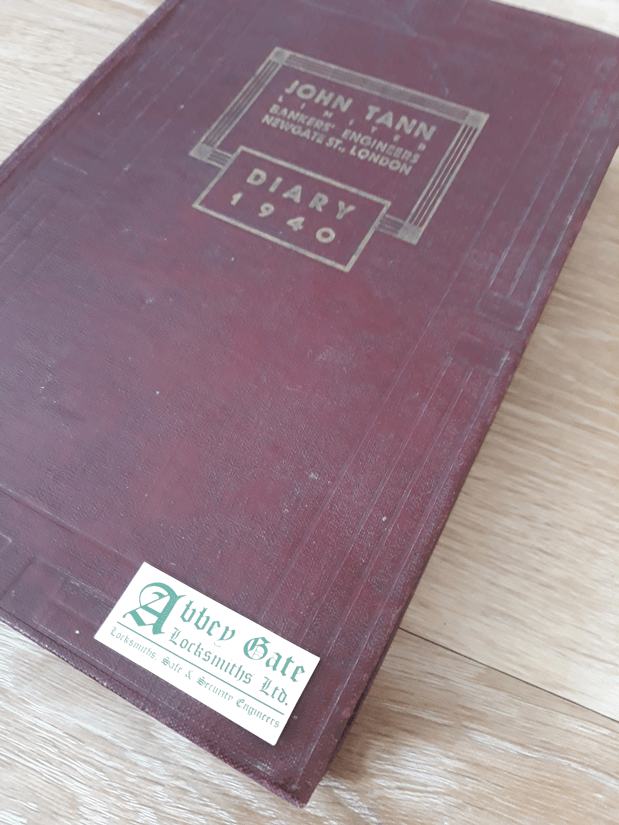
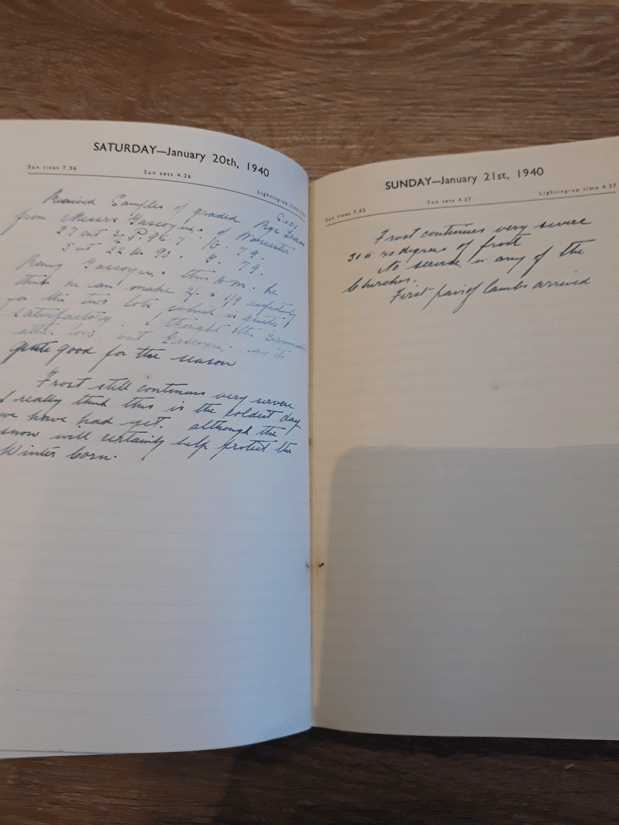
One of our favorite items in our collection is this John Tann safe and vault engineers diary from 1940. The diary and its entry’s provide a fascinating and very rare look into the industry at the time.
The company was founded in 1795 and was originally called Edward Tann and son. In 1845 Edwards son John took control of the business and the name was changed. A little known fact is the companies biggest customer between 1828 and 1836 was Chubb, who would latter become a major rival of John Tann. The company eventually merged with Swedish company Rosengrens in 1940 to become Tann Rosengrens.
John was a keen rower as was his grandson Timothy Crooks, who won a silver medal at the 1976 Olympic games in Montreal.
The photo is from a Milner safe company advertisement from the 1930’s.
The safe was in the Liverpool Philharmonic Hall and survived a fire and fall when the building was destroyed. The orginal hall was designed byJohn Cunningham and opened in 1849 at a cost of £30,000. Today that cost would have been £3.13 million.
The safe saved many autographed books and a cut glass decanter.
Following the fire the hall was re built. Designed by Herbert J.Rowse the hall opend in 1939.
Interested in the history of safe cracking? Find out the amazing true story of Eddie Chapman by clicking here
Naturally our collection contains 100’s of keys of all shapes and sizes spanning 100’s of years and for scores of functions from church, prison and vintage car keys to safe, locker and furniture keys.
Abbey Gate boast a state of the art key cutting machine using a robotic computer run by advanced algorithms to produce near perfect copies. We also boast a British made, (hand driven) Mancuna 750. The machine was built in the 1950’s and at the time of production was also state of the art. Why? Because it used a plastic handle, not common with machinery at the time. Perhaps even more incredible, it still works perfectly. So if we have a power cut, we can still cut keys.
Right and left: Meghan Markle and Prince Harry’s new addition to the family the country once again celebrates a royal occasion. The key pictured was produced to celebrate the wedding of HRH Prince Charles and lady Diana Spencer on the 29th July 1981. The key itself will actuality work a Yale five pin cylinder however we chose not to cut it to work a lock.
This is a Yale booklet from the 1940s/50 and its a guide telling the locksmith how to use their Key bitting machine. Like our Mancuna shown earlier the machine is hand driven. This booklet was printed for the British market at the time when their British operation was known as Yale and Towne baces in Willenhall, Staffordshire.
Above is a mirror from a locksmith/wholesaler produced in 1972 to celebrate 25 years of trading. It is believed that 100 of the mirrors were commissioned. With thanks to John Murphy for further information on the product.
Abovedisplays two posters alongside the receipt also shown below. Both these posters would have been glued to the inside of a safe door as well as being visible in showrooms of the time.
This is not a lock, it’s a biscuit tin. The tin was produced by Huntley and Palmer’s in 1896 from their factory in Reading, Berkshire. The H&P factory that was located on the river Kennet between Reading Prison and Newtown and was once the largest biscuit factory in the world. The Palmer family donated money and land to the Borough of Reading for many causes including Palmer Park in 1889, located between the London and Wokingham Roads.
We like this piece because it has links to both our local and family history.
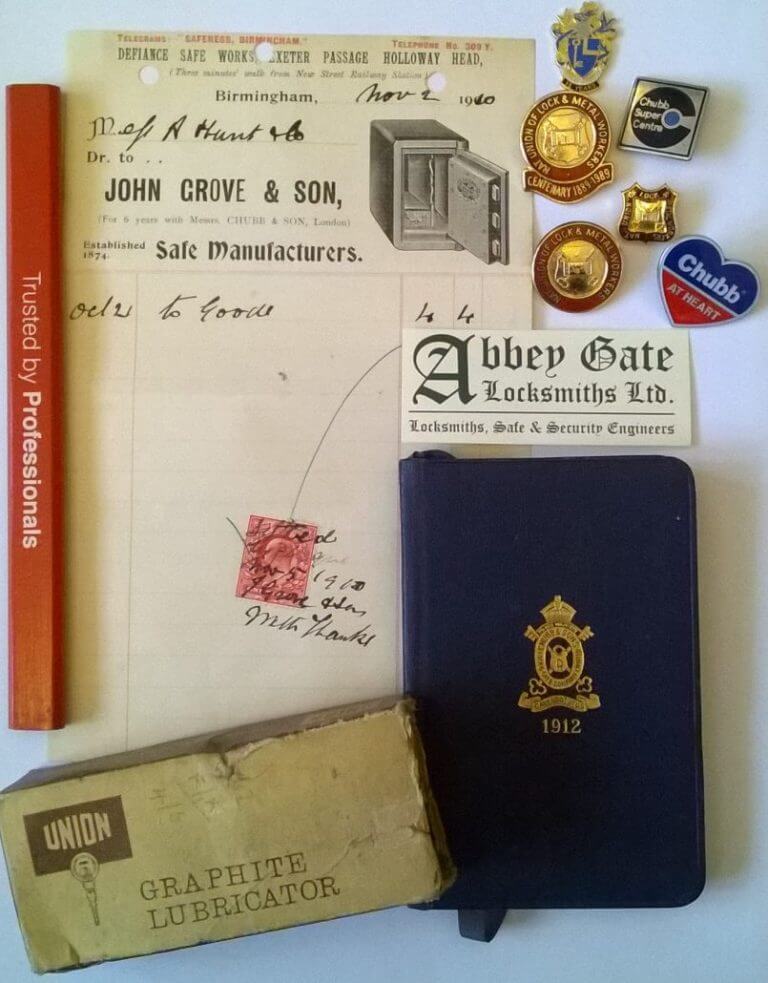
Our collection is not all about locks, it also includes collectables including a safe receipt from 1910, a Chubb pocket diary from 1912, Union graphite lubricant from 1960, National Union of lock and metal workers badges from the 1980’s, a Chubb super centre badge from the early 1990’s, an MLA badge, Chubb at Heart badge and finally a Union pencil from the 2010’s.
Yet again Chubb make another appearance, this time in the form of a toy lorry produced by Matchbox in 1990. Granted its not very exciting and is relatively common but as our collection spans over 100 years we still believe our more modern parts of the collection should get a mention. I would like to say this is the last you will see of Chubb, but over the coming weeks there is more on the way.
Most trade magazines are read, then recycled. somehow these two from January 1991 and December of the same year survived. The gentleman with the Checkmate 2 on the front cover is Jamie Ritchins, a former colleague of Stephens at Smiths Security Services.
Chubb continues its domination of our museum with this really special item. To commemorate the companies 175 anniversary they commissioned this limited edition paperweight in 1993 produced by Halcyon Days Enamels. Charles Chubb was born in Fordingbridge in 1779 and originally traded as a ships ironmonger in Winchester and later Portsmouth in 1804. Chubb moved into the locksmiths industry in 1818 following another move to Wolverhampton. The image of the lock maker on the front of the weight also has the Chubb factory behind him, the very same as photoed at the top of the page.
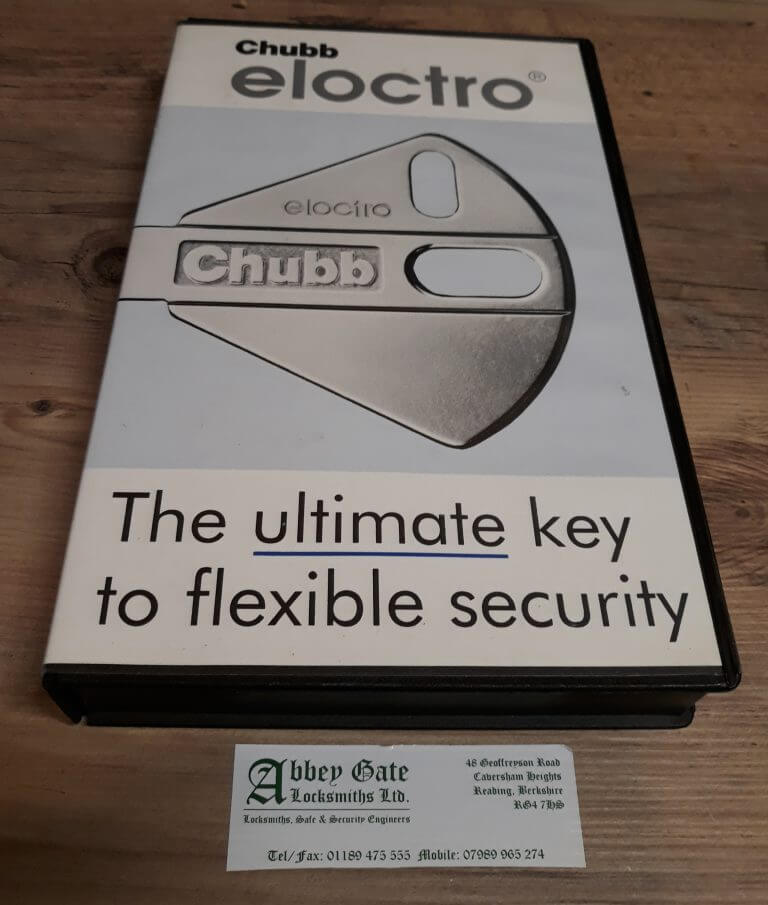
More promotion now by who else, Chubb. For the younger generation these are known as VHS video tapes, before DVDs and online streaming this is how you viewed your movies and sold your products using visual promotion. The tapes have no date but using the “glory days of VCR” as a guide they must be from the 1980’s to 1990’s. The tapes are not very long and we hope to be able to bring them to our YouTube channel currently on the way. Moving images have come a long way.
Another appearance for Yale now with this wonderful “the history of locks” booklet. This booklet was most probably printed for the American market as on the back is the address of their US operation. Yale’s UK operation came when they acquired H&T Vaughan who were based in Wood Street, Willenhall. The Yale booklet has 28 pages and is likely to have been printed in the 1920’s or 30’s.
Another book, this one printed in the 1950’s. Its a fantastic in site in to the history of keys.
Chubb make another appearance in our collection, this time in the form of a receipt from 1958. The receipt was written from their store in London for a customer in Darwen (just south of Blackburn, Lancashire). as you can see the Ironmongers purchased 3 inch mortise deadlocks with 10 inch keeps. At the time Chubb supplied a wide range of locks and safes so receipts like this should be quite common.
The item above is an A4 card price list from 1980 produced by Union. The price list would have been supplied to locksmiths and ironmongers across the country.
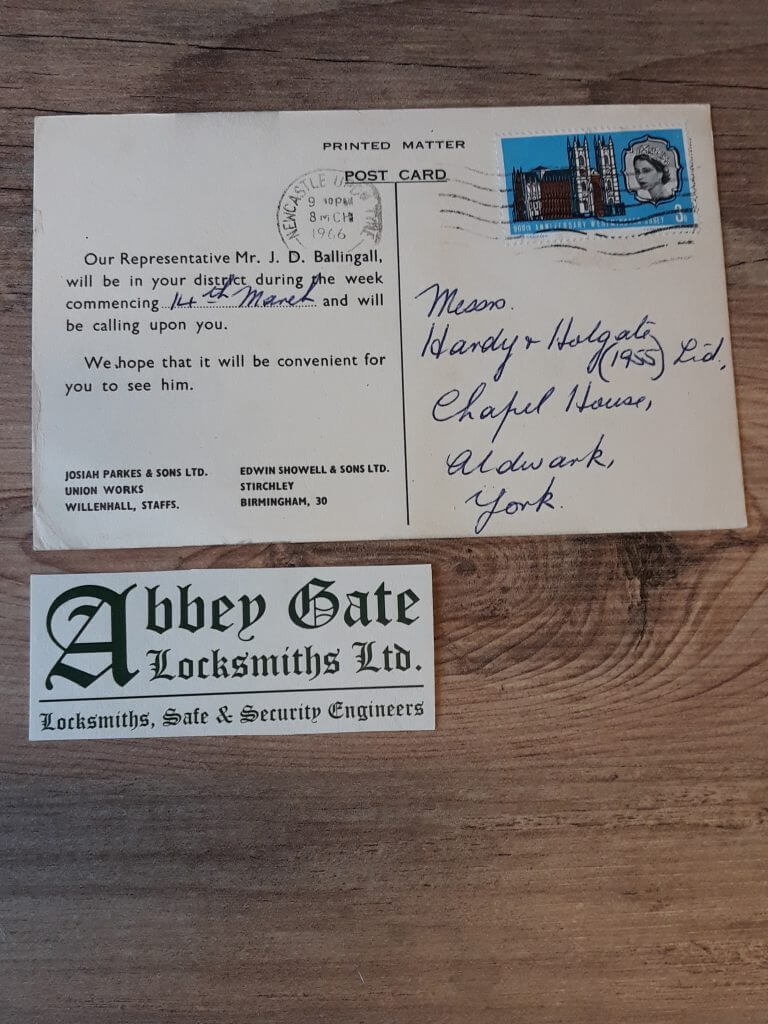
Union began trading in 1840 under the name Josiah Parks and sons Ltd in Willenhall (a town once at the center of the worlds lock manufacturing industry). As the company grew they moved to the Union works in Union street. At this location the name Josiah Parks and son evolved over time to Union. At the Union works the company also produced munitions during the two world wars and suprisingly a two stroke engine.
The lock manufacture Union makes an unusual appearance now, a welcome break from Chubb. This is a hand written post/calling card that was sent to ironmongers and locksmiths across the country. Their representative (Mr J.D Ballingall) came into York on the 14th of March 1966 and may have visited Hardy and Holgate in an attempt to sell Union locks. At the time Union were based at the their Lock and Brass foundry in Willenhall, Staffordshire.
Thank you for taking the time to visit our museum. We hope to add more locks and other items over the course of the year so we hope to welcome you back soon. Please take moment to leave a comment.